souls interlude
An Audio-Visual study of South African jazz between 1964–1974
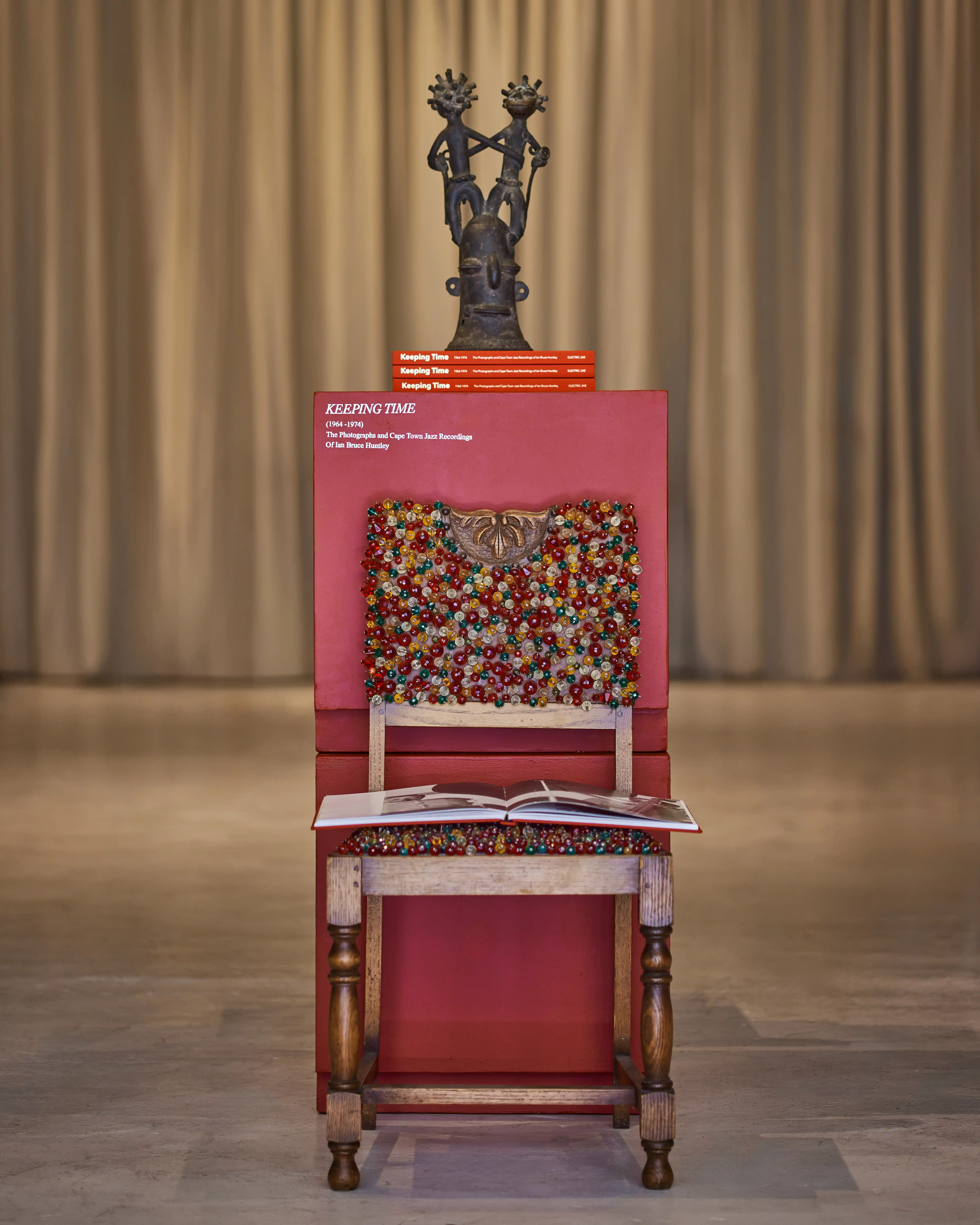
Souls Interlude is an invitation into the rooms, street corners, and improvised stages in which South African jazz was sustained and self-initiated, in spite of the immense threats against it. Drawing on the extraordinary photographs and reel-to-reel recordings of Ian Bruce Huntley, this exhibition offers a rare and intimate account of a musical community that refused erasure and engaged, intuitively, in future-making: creating for better days, though they were yet to be known. From Cape Town to Port Elizabeth, from township halls to private living rooms, the created installations that revolve around the imagery, sounds and literature reveal a culture held together by deep trust and an uncompromising commitment to creative expression.
Presented by Lukhanyo Mdingi, and drawn from the seminal work Keeping Time by Electric Jive, Souls Interlude is a research projects for anyone longing to understand this aspect of South African jazz, music, and memory, and to uncover how art carried futures that the present could not yet hold.
Between 1964 and 1974, jazz in South Africa was a genre steeped in collective courage, shared risk, and the sustaining force of community. It was a way of remaining human in a country determined to limit the terms of being human, and the risk embedded in this practice was profound. Many of the musicians Huntley recorded and photographed were subject to surveillance and harassment. Venues closed without warning; gatherings were policed; interracial collaboration was criminalised. Yet the archive reveals an astonishing continuity of creative momentum; musicians gathered across boundaries the law tried violently to enforce. Instruments were borrowed, petrol pooled, and travel arranged in whispers; a single concert could be shut down without warning; friendships could lead to exile; police could wait outside a door with violent intent, and still, the music continued.
Huntley was not a distant observer, but a participant in this world; his flat became a rehearsal space and an intellectual hang-out. The result is precisely 1,500 images and over 56 hours of live recordings from the point of view of a community member, rather than a voyeur. His photographs show gestures of tenderness and experimentation, the precise concentration of a solo, the laughter that rises between sets; moments held as only someone photographing their own people could hold them, someone for whom this was, quite simply, family.
These images and accompany sounds celebrate the musicians and spaces that shaped this era in the Cape Town most predominantly: from the Langa Community Centre, to the Salt River Town Hall, to the iconic Room at the Top, a venue that nurtured new collaborations, improvisational language and a generation of players who would go on to define South African jazz both at home and in exile. As Jonathan Eato observes in Keeping Time, “No other publicly accessible archive dedicated to jazz in South Africa can demonstrate a corresponding cross-disciplinary engagement in the way that Huntley does.”
In hindsight, these photographs and recordings remind us that an archive is a record of the political, but equally a record of living. It is our reality in South Africa that our histories are inevitably politicised; this is the lasting nature of what was enforced and engineered under such a regime. Still, such archives offer back to us the grains of ordinary time; people being together, gathered under music. In doing so, these works loosened the grip of the system that sought to define every aspect of their lives and movements; revealing that even under a regime determined to manage bodies and restrict futures, people still insisted on the dignity of making, gathering, and becoming.
Souls Interlude honours this insistence. It acknowledges the courage of the musicians who, in the words of drummer Lulu Gontsana, understood that “it was not jazz to play only, it was how to be a human being and to learn to stand on your own.” The exhibition does not claim to tell the whole story of South African jazz; no single telling could. Instead, it holds a space in which such stories can be experienced, returning us to the rooms in which freedom was rehearsed in secret.

 discover the gallery